

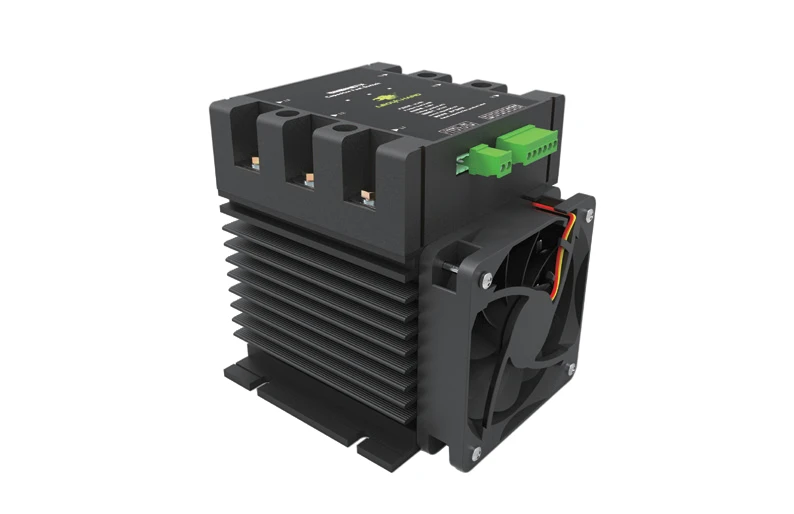
Thyristor Switching Module
The ULHBt Series thyristor switching module is an electronic power device module designed for rapid switching of power capacitors. It is mainly composed of a high-power anti-parallel high-performance thyristor module, isolation circuit, trigger circuit, synchronization circuit, protection circuit, and drive circuit. The module is equipped with terminals for controlling the switch on/off state, with a control logic voltage of 0V (off) and 12V (on).
Product Features
· ULHBc selects different reactance rates according to load characteristics, effectively suppressing 5th and 7th harmonic amplification and ensuring the safety of capacitor branches;
· Phase-by-phase switching adapts to three-phase unbalanced reactive power requirements;
· Cylindrical capacitors with a self-healing explosion-proof design;
· Reactors utilize foil winding technology for excellent heat dissipation;
· Compact structure, easy maintenance, suitable for space-constrained distribution rooms;
· Equipped with overvoltage and overtemperature protection functions to ensure long-term stable operation.
Products Description
The ULHBt Series thyristor switching module is an electronic power device module designed for rapid switching of power capacitors. It is mainly composed of a high-power anti-parallel high-performance thyristor module, isolation circuit, trigger circuit, synchronization circuit, protection circuit, and drive circuit. The module is equipped with terminals for controlling the switch on/off state, with a control logic voltage of 0V (off) and 12V (on).

Data Sheet
| Ultra-Thyristor Switch | |
| Rated voltage | 220V 380V |
| Rated frequency | 50Hz/60Hz |
| Control capacity | 220V(5kvar~15kvar)380V(5kvar~40kvar) |
| Ambient air temperature | -25℃ to +50℃, with an average temperature not exceeding +35℃ over 24 hours; at +25℃, relative humidity can briefly reach 100%. |
| Altitude | ≤4000m³ |
| Installation environment | The installation site must be clean, free of explosive and flammable hazardous materials, gases that could damage insulation or corrode metal, conductive dust, rain or snow intrusion, severe mold, and significant harmonic distortion exceeding limits. |
Q&A
Q: 1.What is a thyristor switching switch?
A: A thyristor switching switch (also known as thyristor‑switched switch, English name Thyristor Switched Capacitor, abbreviated as TSC) is an electronic contact‑less power device module used for the rapid switching of power capacitors.
Take the ULHBt series as an example. The product is mainly composed of high‑power anti‑parallel high‑performance thyristor modules, isolation circuits, trigger circuits, synchronization circuits, protection circuits and drive circuits. It is also equipped with wiring terminals for controlling the switch on‑off state, with a control logic voltage of 0 V (off) and 12 V (on).
It realizes contact‑less switching of capacitors through power electronic technology. Featuring fast response speed, no inrush current, no electric arc, support for frequent operations and long service life, it serves as a core component for dynamic reactive power compensation.
Q: 2.What is the operating principle of a thyristor switching switch?
A: The core component of a thyristor switching switch is an anti-parallel thyristor module (consisting of two thyristors connected in anti-parallel), whose conduction and off-state are controlled by a gate triggering signal:
(1)Turn-on process (zero-crossing voltage triggering): The synchronization circuit performs real-time monitoring of the voltage across the thyristor; when the voltage crosses zero, the triggering circuit generates a pulse signal to turn on the thyristor. Since the capacitor is connected at the zero-crossing point, the voltage across the capacitor is identical to the grid voltage; therefore, the theoretical inrush current is zero.
(2)Operating process: The thyristor remains continuously conducting, allowing current to flow through the thyristor module. Since the turn-on voltage drop of the thyristor is approximately 1–1.5 V, power dissipation and heat generation occur during operation; therefore, a heat sink must be used for heat dissipation.
(3)Disconnection process (current zero-crossing turn-off): Upon removal of the gate triggering signal, the thyristor turns off at the natural zero-crossing point of the AC current, achieving arc-free interruption. After disconnection, the capacitor discharges itself through a discharge resistor.
(4)The entire switching process is completed within 1–20 ms – significantly faster than that of a mechanical contactor.
Q: 3.What is "zero-crossing switching"? Why does it enable zero inrush current?
A: Zero-crossing switching refers to the technique of switching a capacitor in at the zero-crossing point of the AC voltage and switching it out at the zero-crossing point of the AC current.
Zero-Current Principle:
(1)The magnitude of the inrush current during capacitor energization depends on the difference between the voltage across the capacitor at the moment of energization and the grid voltage.
(2)When energized at the voltage peak, the voltage difference is maximized, and the inrush current can reach dozens of times the rated current.
(3)When the capacitor is switched on at the voltage zero-crossing point, its pre-charging voltage is equal to the grid voltage, resulting in a zero voltage difference; consequently, the theoretical surge current is zero.
(4)In actual applications, due to detection and triggering delays, the inrush current is typically kept within three times the rated current – a value significantly lower than the dozens of times observed during contactor switching operations.
Zero-crossing switching is the core advantage that distinguishes thyristor switches from traditional contactors; it provides effective protection for capacitors, contactor contacts, and the power grid.
Hot Tags: thyristor switching module, China thyristor switching module manufacturers, suppliers, factory


Send Inquiry
