

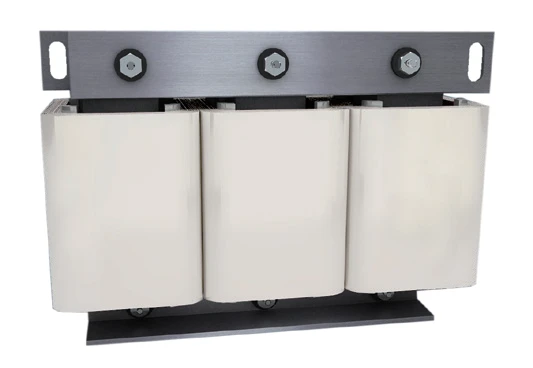
Low-voltage Series Reactors
The ULHBr series low-voltage series reactors use high-quality cold-rolled multi-layer silicon steel sheet cores, enabling more stable operation. The ULHBr series reactors feature low no-load loss, good linearity, strong overcurrent capacity, high harmonic resistance, low noise, and long lifespan. The reactor windings are extruded and folded using specialized equipment, solving the defects caused by uneven conductor tension in general reactors, and achieving H-class temperature resistance standards.
Product Features
· ULHBc selects different reactance rates according to load characteristics, effectively suppressing 5th and 7th harmonic amplification and ensuring the safety of capacitor branches;
· Phase-by-phase switching adapts to three-phase unbalanced reactive power requirements;
· Cylindrical capacitors with a self-healing explosion-proof design;
· Reactors utilize foil winding technology for excellent heat dissipation;
· Compact structure, easy maintenance, suitable for space-constrained distribution rooms;
· Equipped with overvoltage and overtemperature protection functions to ensure long-term stable operation.
Products Description
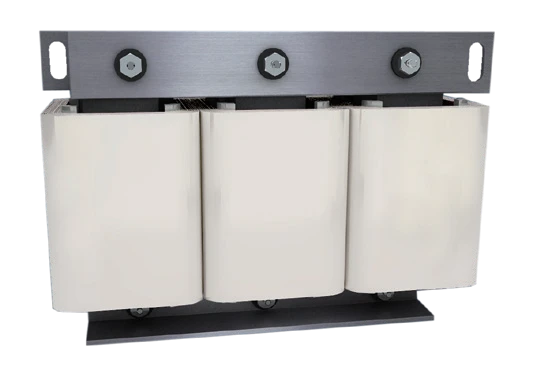
The ULHBr series low-voltage series reactors use high-quality cold-rolled multi-layer silicon steel sheet cores, enabling more stable operation. The ULHBr series reactors feature low no-load loss, good linearity, strong overcurrent capacity, high harmonic resistance, low noise, and long lifespan. The reactor windings are extruded and folded using specialized equipment, solving the defects caused by uneven conductor tension in general reactors, and achieving H-class temperature resistance standards.
Data Sheet
| Low-voltage series reactor | |
| Technical standards | IEC76 IEC289 EN60289 |
| System voltage | 220V 380V 660V |
| Rated frequency | 50Hz/60Hz |
| Rated power | 10-100kvar |
| Tuning frequency | 134Hz(14%)189Hz(7%) |
| Inductance tolerance | ±3% |
| Insulation class | Class H (180℃) |
| Installation location | Located above the capacitor |
| Maximum harmonic overload | 0.35In |
| Matching capacitor rated voltage | 250V 280V 450V 480V 525V 750V |
| Over-temperature protection | Built-in protection via thermistor and reactor over-temperature protection connection (over-temperature protection activates when reactor temperature exceeds 170℃) |
Q&A
Q: 1.What are the main functions of a series reactor?
A: Low-voltage series reactors have three core functions:
(1)Suppressing harmonics and preventing parallel resonance: Capacitors and system inductors may resonate in parallel at a certain harmonic frequency, causing harmonic current to amplify several times or even tens of times, burning out the capacitor. Series reactors can lower the resonant frequency below the system's main harmonic frequency, fundamentally avoiding resonant amplification.
(2)Limiting inrush current: The inrush current generated when a capacitor is switched on can be tens of times the rated current. Series reactors can limit the inrush current to a safe range (usually 5-10 times the rated current), protecting the contactor contacts and capacitors.
(3)Auxiliary filtering: The LC circuit formed by the reactor and capacitor has low impedance to harmonics near the tuning frequency, absorbing some harmonic current and providing a certain filtering effect (the filtering rate can reach 30%-60% when well matched).
Q: 2. Is it normal for a reactor to overheat severely during operation? How can I determine if it's overheating?
A: Overheating during reactor operation is normal (due to copper and iron losses), but overheating is a fault signal.
Normal temperature rise range:
F-class insulation: Average winding temperature rise ≤ 85K (average winding temperature ≤ 125℃ at ambient temperature 40℃)
H-class insulation: Average winding temperature rise ≤ 100K (average winding temperature ≤ 140℃ at ambient temperature 40℃)
Overheating assessment methods:
(1)Touch: If the outer casing is hot to the touch (above 70℃) and continues to rise, it may be overheating.
(2)Infrared thermometry: Measure the surface temperature of the windings and core using an infrared thermometer. For F-class, the temperature should not exceed 140℃ (hottest point); for H-class, it should not exceed 165℃.
(3)Odor: A burnt smell from the insulating varnish indicates severe overheating.
(4)Discoloration: Discoloration or blackening of the winding insulating varnish indicates prolonged overheating.
Common causes of overheating:
Excessive harmonics, reactor overcurrent; improper reactance selection, circuit detuning; poor heat dissipation (poor ventilation inside the cabinet, insufficient installation spacing); loose reactor core, increased iron losses; capacitor capacitance decay, leading to LC circuit parameter deviation.
Hot Tags: low-voltage series reactors, China low-voltage series reactors manufacturers, suppliers, factory


Send Inquiry
